






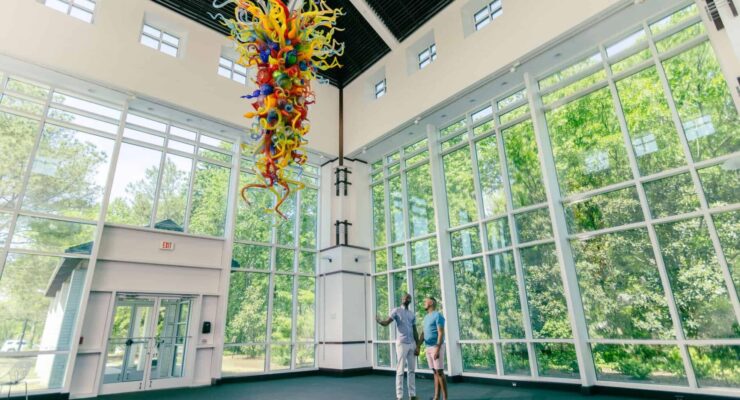
Most people come to Virginia Beach for the obvious reasons: the Atlantic, the boardwalk, the easy pace of a coastal weekend. But if you pay attention to the spaces in between, the city has something quieter going on. A handful of places here take design seriously, and they’re worth seeking out if that’s the kind of thing you notice.
The clearest example is the Cavalier Hotel, which reopened after a major restoration and immediately reminded everyone what it looks like when a building is treated with genuine care. The interiors reference the hotel’s 1927 origins without turning the whole thing into a period piece, a balance that’s harder to pull off than it sounds. Virginia Beach has more refined spaces than most visitors expect: it’s not unusual to walk into a well-appointed hotel lobby or restaurant and find yourself sitting on Poltrona Frau or Cassina chairs.
The Virginia Museum of Contemporary Art
The Virginia MOCA sits just off the resort strip, close enough to feel accessible and far enough to attract a crowd that actually came for the art. The building itself is a decent piece of architecture: clean, well-proportioned, unpretentious in a way that lets the work inside take priority. The permanent collection is modest, but the programming skews toward contemporary work with a regional pull, and traveling exhibitions have brought in pieces from much further afield. There’s also a sculpture garden that gets overlooked by visitors who move straight to the main galleries. If you’re spending a few days in Virginia Beach and want an hour or two that feels less like vacation and more like something to think about on the drive home, this is the stop.
Sandbridge and the Architecture of Restraint
A fifteen-minute drive south of the main resort area, Sandbridge operates at a different register entirely. The vacation homes here have actual space between them, and the better ones sit quietly in the landscape rather than competing with it. No oversized decks trying to announce themselves, no facades loaded with coastal decorative signals. The design logic, if you can call it that, tends toward proportion and material choice: cedar shingles, pale wood, colors that are less chosen than allowed. Things that weather into the dunes rather than fighting them. It’s not a design destination in any formal sense, but driving through on a clear morning, it makes a case for a kind of architecture that understands when to stop adding things.
The Boardwalk Art Show and What It Says About the City
Every June, the Virginia Beach Boardwalk Art Show takes over the oceanfront for four days. It’s one of the oldest juried art fairs on the East Coast, running since 1955, and the range of work on display (painting, sculpture, photography, mixed media, fiber art) is considerably broader than you’d expect from a beach destination. Around 350 artists typically exhibit, and the quality threshold is high enough that serious collectors make the trip specifically for it. For a design-minded visitor, it’s a useful lens on the city. The show doesn’t curate around a single aesthetic, which means you end up seeing things that clash productively. A sculptural piece in weathered steel next to a detailed botanical illustration. Ceramic work that could sit comfortably in a well-appointed kitchen alongside prints that belong in a surf shop. The lack of imposed coherence is, oddly, what makes it worth spending time at.
Where the City Is Heading
Virginia Beach has been expanding its arts and cultural infrastructure with some consistency, and the newer commercial developments around Town Center, the city’s inland business district, are starting to show more deliberate design choices. Public art installations that aren’t just filler, facade treatments that reference the coastal context without resorting to obvious nautical clichés, lobbies in newer hotels that take the furniture seriously. It’s incremental progress rather than a transformation, but the direction is clear. For visitors who care about how a city looks and feels, not just what it offers, that’s enough reason to pay attention, and to plan a return visit with slightly different priorities than the first time around.



 Events


