






Historical horse racing machines look like slots, sound like slots, and pay like slots. But legally they’re bets on horse races that already happened. Virginia allowed them in 2018, when Governor Ralph Northam signed the bill that brought them in, and the first Rosie’s location opened in New Kent County in April 2019. Since then, I’ve heard plenty of opinions about these machines and seen very few actual numbers. So on Saturday, March 14, 2026, I drove from my place in Virginia Beach to Rosie’s Hampton with $300 in cash and a pocket notebook, and I wrote down every session.
I’ve covered sports betting and casino math for close to a decade. I’m not a high roller. My usual bet is smaller than a coffee, and I care more about where the money goes than whether I win on any given night.
Most of my weekday play happens online, and these days that’s usually on BetFury, where I spin crypto slots online in short sessions and can check a game’s listed return before I bet a cent. That habit followed me to Hampton. I wanted to know whether a machine tied to old horse races would feel any different from a regular reel game, and whether my money would last longer or shorter.
The comparison isn’t perfect (online games and pari-mutuel machines run on different math), but it gave me a baseline. On BetFury, I can set a session limit and see my history in seconds. At Rosie’s, I had a pen. That gap turned out to matter more than I expected.
The Drive From Virginia Beach to Hampton
It’s about 31 miles one way if you take I-64 west through the Hampton Roads Bridge-Tunnel. I left at 6:20 p.m. and parked at 6:58, which is fast for a Saturday. Anyone who lives here knows the tunnel can turn a 35-minute drive into 70 with zero warning.
Gas for the round trip came to roughly $9. Parking was free. I note this because it’s real spend, and most “my night at the casino” stories skip it.
How Historical Horse Racing Machines Actually Work
The Race Behind the Reels
When you press the button, the machine pulls a random race from a database of thousands of past races. Track names, dates, and horse names are hidden. You get a small handicapping chart, and you can pick your own top three finishers or hit a “quick pick” button that picks for you. Almost everyone hits quick pick. I did too, about 95% of the time, because picking horses every 12 seconds gets old fast.
The reels and bonus graphics are just a display of the result. Your money goes into a pari-mutuel pool shared with other players on the same game, which is why payouts can feel a little different from a standard slot. Once, I paused to watch the replay clip, and the race was from a mid-Atlantic track in 2016. Some horse that probably retired years ago had just decided whether I got back $0.80 or nothing. Weird thought. Kind of charming, though.
What the State Requires
Virginia rules require these machines to pay back at least 90% over time, according to the state’s racing regulations. That’s a floor, not a promise for one night. And since the pool is shared, the payback on any single machine you sit at might drift above or below that line for a long stretch.
My Bankroll Plan and the Rules I Set
Before I walked in, I wrote down a few rules on the first page of my notebook. Nothing fancy.
- Hard cap of $300 for the night, with no ATM visits
- Start at $0.40 per spin and only move up after a session in profit
- Log start time, end time, bet size, spins, and cash out for each session
- Leave by 11:30 p.m., no matter what
Did I follow all of them? Mostly. One rule bent a little, and I’ll get to that.
Session by Session: Real Spend and Results
Session One, 7:12 p.m. – Feeling Out the Floor
I started on a $0.40 game near the back wall, away from the noise by the bar. Over 46 minutes, I played 230 spins. That’s $92 in total bets. The machine paid back $71.60, so I was down $20.40, and my biggest single hit was $6. Pretty flat. The pace surprised me, though. Five spins a minute is quicker than I play online, and it eats cash without you really noticing.
Session Two, 8:05 p.m. – The Good Stretch
I moved to a $0.80 game, which broke my own rule since session one was a loss. I told myself the first game was “cold.” That’s exactly the kind of thinking I warn readers about. Anyway, it worked out. Across 190 spins and 57 minutes, I bet $152 and got back $198.40, a profit of $46.40 for the session. The big moment was a bonus round that paid $64, or 80 times my bet, about 20 minutes in. The man next to me (retired Navy, from Newport News, very chatty) leaned over and said, “That one’s got legs.” Then he lost his next 15 spins and went quiet.
Session Three, 9:15 p.m. – Bumping the Bet
This is where things went sideways. Up $26 for the night, I doubled to $1.60 per spin. In 55 minutes I played 120 spins, put $192 through, and got back $141.20. Down $50.80. No bonus hit at all, just a string of tiny wins that kept me in my seat. Why does a $2.40 win on a $1.60 bet feel like progress? It isn’t. It’s a loss that comes with music.
Session Four, 10:20 p.m. – Cooling Down
I dropped back to $0.80 and played 150 spins in 45 minutes. Total bets came to $120, and the machine returned $109.60, so I lost another $10.40. I grabbed a $14 burger and fries near the end, cashed out at 11:08 p.m., and was on the road by 11:15.
What the Numbers Say About HHR Play
Here’s the full night in plain figures, straight from the notebook.
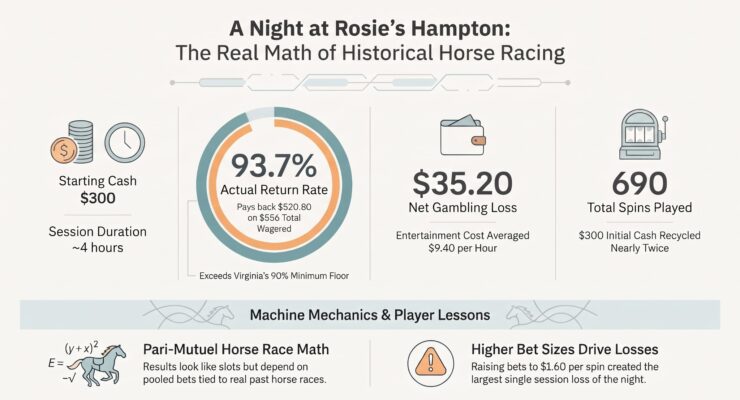
- Total spins: 690
- Total money bet: $556
- Total paid back: $520.80
- Net gambling loss: $35.20
- Actual return: about 93.7%
- Gas and food: $23
- Cash in my wallet at the end: $264.80
So the machines kept $35.20 of my money over roughly three hours and 45 minutes of play. That works out to about $9.40 an hour, which is honestly cheaper than a movie and dinner in Hampton. The 93.7% return landed above the state’s 90% floor, but I wouldn’t read too much into that. With only 690 spins, one $64 bonus swung my night by more than the whole final loss. If that bonus never hits, I’m down closer to $100, and this article probably reads a lot gloomier.
The bigger lesson was about money moving through the machine. I started with $300 and bet $556 in total, which means I recycled my wins nearly twice. That’s normal for any slot-style game. But people tend to remember the $300 they brought and forget the $556 they actually risked. And the $1.60 session did most of the damage, even though it was the shortest one by spin count.
Tips for First-Timers Driving Over From the Beach
A few things I’d tell a friend before they make the same drive. Some are about money, and some are just practical.
- Check traffic at the tunnel before you leave. Seriously.
- Pick a bet size where 300 spins won’t wreck your budget, then stay there
- Use quick pick without guilt, since the handicapping chart gives you very little real edge
- Write down your numbers, even on your phone, because the machine won’t show you a running total for the night
- Eat something early (I didn’t, and I think hunger pushed me into that $1.60 game)
Would I Drive Back to Rosie’s Hampton?
Probably, yes. Not every week. The floor was clean, staff were friendly, and the spin speed is fair for the price. But I’d skip the bet bump next time, and I’d bring the same notebook. Losing $35.20 for a full Saturday night of play didn’t sting much. Losing control of the bet size for one hour easily could have.
The retired Navy guy was still at his machine when I left, by the way. He waved. I hope his horse finally found its legs.




 Events


